Cave / Rocks Sights in Mallorca — 6 of Our Favourites

Discover and book the top Mallorca sights

Sa Calobra & the Torrent de Pareis, West Mallorca

1. Sa Calobra & the Torrent de Pareis, West Mallorca

Location
Sa Calobra

Do not believe anyone who tells you that they have discovered the perfect unspoilt cove on the west coast - unless of course the name is Sa Calobra. This is indeed a beautiful spot, which is why tour buses pour in by the dozen every day, even in winter.

 Surrounded by serious mountains, this place has a beautiful cove, a hidden beach and an incredible gorge. Despite all the visitors flocking here to view the stunning scenery, it is a pretty spectacular place.

The journey to Sa Calobra is as memorable as the bay itself. A twisting road around Puig Major plunges 800m in just 12km, turning 270 degrees at one point to loop under itself (a feature known as the 'Knotted Tie'). A much better and easier approach is by boat from Port de Soller, passing genuinely isolated bays with an excellent view of Puig Major, albeit spoilt by the military installations on the summit of Mallorca's highest mountain.

Once there, walk through 200m of tunnels to reach the Torrent de Pareis ('twin streams'), which begins several kilometres up in the mountains at the confluence of the torrents of Lluc and Gorg Blau. Up to 400m high and only 30m wide, with some sections never seeing daylight, this dramatic gorge culminates in a small pebble beach where you can picnic among the crowds. In summer, when the gorge is dry, you can hike inland between the cliffs; do not attempt this in winter. Take a look at our report on the hike to see what it's like - Torrent de Pareis Gorge Walk

A side turn off the road to Sa Calobra leads to Cala Tuent, a small cove with a sandy beach and a 13th-century church, Ermita de Sant Llorenc. Cala Tuent is likely to be quieter than Sa Calobra and is worth visiting for it's lovely blue-green sea.
a photo of underground caves

2. Coves de Campanet

Location
Campanet

The Caves of Campanet are situated in the north of Mallorca in the foothills of the Tramuntana mountains. The caves cover a surface area of approximately 3,200 square metres at a depth of 50 metres

You can take a tour, which lasts about 40 minutes, that follows a pathway through different passages and chambers, some of which have small water pools.These chambers are known by such romantic names as Sala Romántica (the Romantic Chamber), Sala del Lago (the Lake Chamber), Castillo Encantado (Enchanted Castle), Sala de la Palmera (the Palm Tree Chamber), Cascada Sonora (Musical Waterfall) etc.

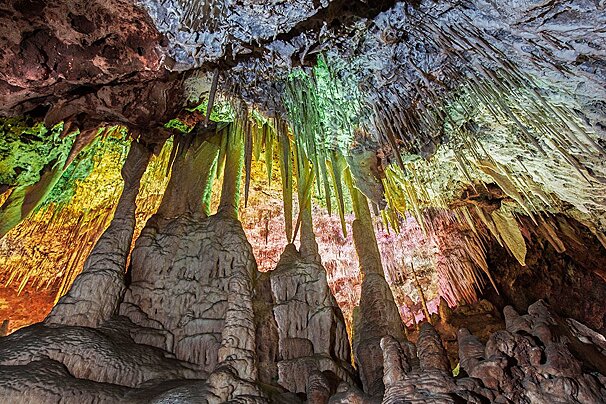
The caves are noted for the fineness and richness of their calcareous deposits in the form of stalactites and stalagmites. The caves have inspired painters such as Casimir Tarrassó who dedicated a series of signed oils to them in 1948; and poets such as Bartomeu Guasp i Gelabert who composed the ode "Caves of Sant Miquel" (1949).

They are open every day from 10am.

Cuevas dels Hams, Porto Cristo

3. Cuevas dels Hams

Location
Porto Cristo

You cannot miss these caves as you drive from Manacor to Porto Cristo. Most people only want to visit one set of caves during their time on Mallorca and the giant billboards and flags at the entrance are an attempt to ensure that this is the one. In fact you are better off continuing to the 'Cuevas del Drach' or up the coast to the 'Coves d'Arta'.

But for serious speleologists, here are the facts. The caves were discovered by Pedro Caldentey in 1905 and the electric lighting was added by his son. Their name means 'fish hooks', which the stalactites are said to resemble. You get a guided tour and, yes, another concert on an underground lake.

The caves also make for a wonderful venue for weddings and parties.

Exploring Arta Caves

4. Caves d'Arta

These caves near Arta, in the north-east of Mallorca, are a fascinating network of underground caverns whose weird stalactites and stalagmites conjure up mysterious images of Heaven and Hell. An early visitor was Jules Verne, the caves are said to have inspired his Journey to the Centre of the Earth.

Now that the caves are a tourist attraction, it is hard to imagine how French geologist Edouard Martel felt when he first stepped into them in 1876, dark, mysterious and terrifying. In fact, they had been known about for centuries. Jaume I found 2000 Arabs hiding here with their cattle during the Christian conquest and they were later used by hermits, pirates and smugglers. But it was Martel who first studied and chronicled these grottoes at the instigation of Archduke Ludwig Salvator. 

The guided tour comes with special effects and the various chambers are given Dantesque names: Hell, Purgatory, Paradise. The descent into Hell is swiftly followed by a light and sound display. Stalactites hang down from the high arched roof like daggers defying gravity. One of the chambers is as large as the nave of Palma Cathedral and the Queen of Pillars, a stalagmite 22m tall, could almost be a Gothic column. It is growing upwards at the rate of 2cm every 100 years, which means that, in another 5000 years or so, it will be joined to the ceiling.

You emerge from the caves to a view of the sea, framed by the cavern entrance. Read about our experience exploring the Artà Caves.

Cuevas del Drach (Dragon Caves), Porto Cristo

5. Cuevas del Drach (Dragon Caves)

Location
Porto Cristo

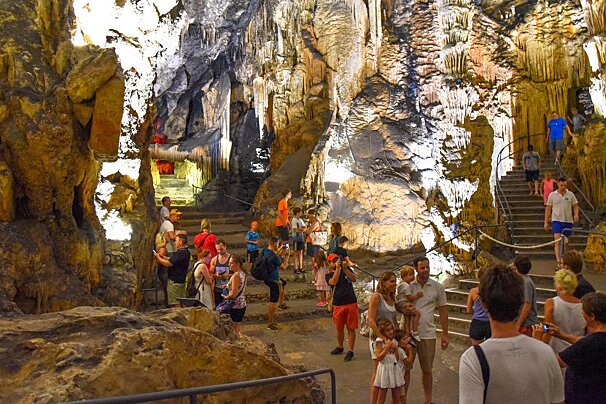
Dark and cool, these limestone caves on the edge of Porto Cristo have become one of Mallorca's top tourist sights. Groups walk along 1200m of smooth paths exploring the magnificent stalactite formations within. 

The Cuevas del Drach (or Dragon Caves) were already known during the Middle Ages. These calcareous formations were formed between 11 and 5.3 million years ago, during the Miocene era. Between 1922 and 1935, they were conditioned to be visited by opening a new entrance, building paths, stairs and installing electric lighting. The tour takes about an hour and includes a classical music concert and a boat trip. The temperature inside is about 21°C and the humidity an 80%.

The colours and formations within the cave are truly astonishing and those with a creative imagination will see formations resembling a cactus, a flag and even a snowcapped mountain. There is also the Baths of Diana and a multitude of fantastic stalactites that grow 1cm every 100 years.

The tour ends with a floodlit, floating violin concert on Lake Martel, Europe's largest underground lake, about 170 metres long and between 4 and 12 metres deep. The lake is named after the French geologist Edouard Martel who first explored these caves in the late 19th century, at the commission of Archduke Ludwig Salvator. Afterwards you can return by boat across the lake to the exit.

Cap de Formentor

6. Cap de Formentor, North Mallorca

This wild peninsula on Mallorca's northeast tip has stunning views, sandy beaches and the island's original luxury hotel. The 20-km drive from Port de Pollenca to Mallorca's most northerly point has scenery as dramatic as anyone could wish for. Cliffs 400 metres tall jut into the sea, their weird rock formations attracting nesting seabirds, while pine trees seem to grow out of the rocks.

The drive is also famously scary. A local legend has it that the parish priest and the local bus driver arrived at the Pearly Gates and only the driver was admitted to heaven. The reason? He had led far more people to pray. Six kilometres from Port de Pollenca you reach the view point of Mirador des Colomer - scramble up the steps for views over a rocky islet. A path opposite the steps leads to an old watchtower from which you can see the whole of the peninsula, as well as the bays of Pollenca and Alcudia.

The road continues through pine woods and past more view points (each one helpfully indicated with a picture of an old-fashioned camera) before tunnelling through En Fumat mountain, where you look down over Mallorca's most inaccessible beach. Eventually you reach a lighthouse with the inevitable bar and shop and more stunning views, all the way to Menorca on a good day.

On the way back, stop at Formentor beach and the newly reburbished Hotel Formentor. It opened in 1929 and has been pampering the rich and famous ever since. The fine sandy beach used to be reserved for the hotel's guests, but is now open to the masses.