
Religious Sights in Mallorca — 12 of Our Favourites

Discover and book the top Mallorca sights

Lluc Sanctuary, Lluc

1. Lluc Sanctuary, Lluc

Mallorca's most sacred site - a former monastery in a spectacular setting in the Serra de Tramuntana mountains to the north west of Mallorca.

Lluc has been a centre of pilgrimage since the 13th century when an Arab shepherd boy, newly converted to Christianity, discovered a dark wooden statue of the Virgin in a cleft in the rock. The image was placed in the local church but three times it returned miraculously to its cave, whereupon the villagers recognised a message from God and built a shrine to house it.

La Moreneta ('the Little Dark One') is now encrusted with precious stones, and sits in a chapel decorated with the arms of every Mallorcan town. Pilgrims and tourists queue to pay homage, especialy on Sundays and at 11am before the daily concerts by Es Blauets choir. The choir, named after their blue cassocks, was established in 1531 comprising 40 boys, 'natives of Mallorca, of pure blood, sound in grammar and song'. The service is marred by the whirring and flashing of cameras, and if it's meditation you seek, come back instead for the evening Mass.

The monastery complex includes Els Porxerets, the former pilgrims' quarters with stabling beneath the rooms, and the Way of the Rosary, with touches by Antoni Gaudi. A very charming rockery & botanical garden is featured in the grounds. From the hilltop cross you look down over an unexpected farm and valley and up into the pinecovered mountains.

You can stay at Lluc but it is more like a hotel than a hermitage the 100 'cells' have en-suite bathrooms and there are several restaurants and bars. There is also a museum - among the displays of ceramics, chalices and coins is a collection of paintings by the 20th-century Mallorcan artist Josep Coll Bardolet, with scenes from Deia, Valldemossa and Fornalutx.
The Royal Carthusian Monastery, Valldemossa

2. The Royal Carthusian Monastery (Real Cartuja), Valldemossa

Location
Valldemossa

Visit the monastery at Valldemossa, where Chopin and George Sand spent the winter of 1838-9. The Real Cartuja (Royal Carthusian Monastery) was originally a royal residence, until Carthusian monks occupied the building from 1399 until 1835.

The origins of the cartuja date back to the time of king Jaume II, who chose this spot to build a palace for his son Sancho. In 1399, it was donated to Carthusian monks. 

It has white-arched corridors leading to 'cells' containing museums on various themes. Visit the old pharmacy - you can almost smell the herbs - then look into the library, where the monks would meet for half an hour a week, their only human contact. There is a fine modern art museum, with works by Picasso, Miro and Juli Ramis, and of course there is Chopin's cell...

Read about our Trip to the Ral Cartuja.

a photo of a large building on top of a hill

3. Sanctuary de Sant Salvador, Felanitx

Location
Felanitx

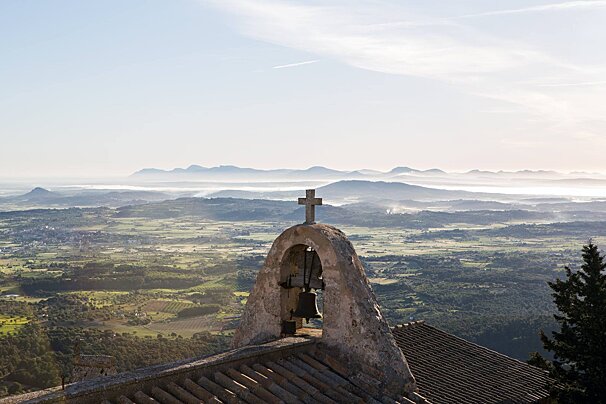
This old hermitage, 509m above sea level at the highest point of the Serra de Llevant near the town of Felanitx, was the senior house of Mallorca's monastic order and the last to lose its monks in 1992.

It is still a popular place of pilgrimage, flanked by two enormous landmarks - to one side a 14m stone cross, to the other a 35m column topped by a statue of Christ holding out his right hand in blessing.

The church contains a fine carved alabaster retable, but more interesting is the side chapel off the gatehouse, full of poignant mementos and prayers to Our Lady. Like other former monasteries, Sant Salvador has a few simple rooms available for pilgrims and visitors.

The views from the terrace take in Cabrera, Cap de Formentor and several other hilltop sanctuaries dotted across the plain. From the statue of Christ you look out towards the Castell de Santueri, a 14th century rock castle built into the cliffs on the site of a ruined Arab fortress. 

Santuary de la Mare de Deu del Puig, Pollenca

4. Santuary de la Mare de Deu del Puig

Location
Pollenca

Nuns settled on Puig de Maria ('Mary's mountain') in 1371 and remained for several hundred years, refusing to leave even when the Bishop of Palma ordered them down for their own safety.

The convent is still there, on top of the mountain - the chapel smells of incense and the refectory of woodsmoke. You can stay in simple rooms in the sanctuary here, but don't expect luxury - you pay extra if you take a shower. The caretaker will rustle up a paella for dinner to save you the long walk back to town.

The puig is a hill just outside of Pollenca, and takes about an hour to climb, or you can drive up a terrifying & narrow potholed road, and be rewarded with views over Cap de Formentor and the entire northeastern coast - as well as back down over Pollenca. If you'd like to know a bit more about the walk to the monastery and it's restaurant & accomodation, read our Activity Report, The Puig de Maria & Monastery, Pollenca

a photo of the church in manacor majorca

5. Esglesia de Nostra Senyora dels Dolors

Location
Manacor

The construction of the church began at the end of the 19th century. It was overseen by priest Rubí and the builder Gaspar Bennàssar, who directed the works and built the bell-tower, the highest building in town known as Torre Rubí.

This site seems to have been a cult place in the Islamic period. It is the place where, after the conquest of Jaume the First, the church of Santa Maria was situated. As this temple was very small, in the 14th century another one was built, which was finished in the 16th century. The main doorway, originally situated on the side of the bell-tower, dates from the end of the 18th century. This church was demolished to build the church we see today.

Some parts of the 18th century still remain, like the chapels of Sant Antoni and Sant Francesc, the towers of the ancient main façade at both sides of the bell-tower, part of the Mother of God sacristy and part of the old bell-tower. Built in negothic typology it has a latin-cross floor shaped one-hall basilica with chapels between the buttresses, with its transept arms in the fore section to the presbytery. There are ten aisles, five on every side, and in the chancel there is one chapel on every side and in the high altar. On every transept arm there are seven chapels, standing out the one consecrated to the Immaculate Virgin and the other to the Sant Crist of Manacor.

Esglesia de la Transfiguracio del Senyor, Arta

6. Esglesia de la Transfiguracio del Senyor, Arta

Location
Arta

Located on the hillside of Sant Salvador above Arta this building dominates the skyline over the town of Arta.

In a Neo-Gothic tradition, its construction began in 1573 to replace the original thirteenth-century church, which had become too small. In the seventeenth century works it is completed header, and the vault in 1816. The Annex is the seventeenth century bell tower.

Outside the building you can see the side buttresses supporting the vault and the lateral dome that illuminates the church. Inside there are up to 14 small chapels dedicated to different saints. The altarpiece was installed in 1906, and represents various scenes of the Transfiguration of the Lord. Other elements are the baptismal font in 1672, the organ of the nineteenth and twentieth century impressive stained glass windows.

Read our review of a visit to the church here.

Puig de Randa & Santuari de Cura, Central Mallorca

7. Puig de Randa & Santuari de Cura, Algaida

The Puig de Randa, rising 543m out of the plain, has been a place of pilgrimage ever since Ramon Llull founded Mallorca's first hermitage here in 1275.

Llull arrived aged 40, shaken by an incident that made him re-assess his way of life. Bent on seduction, he had chased a married woman through Palma on horseback. Unable to shake him off, she lifted her blouse to reveal cancerous breasts, and Llull retired in isolation to Puig de Randa to ponder a life of youthful excess.

These days pilgrims to Puig de Randa are as likely to be weekend cyclists in search of a challenge, as they are seekers of religious truth. The winding road to the summit leads to three separate hermitages.

The lowest, Oratori de Nostra Senyora de Gracia, is perched on a ledge on the cliff above a sheer 200m drop. Further up is the Santuari de Sant Honorat and finally Santuari de Cura, where Llull lived. The sense of history is somewhat offset by the radio mast on the mountain top and the electric candles in the church, but this is still a special place.

Visit the Sala Gramatica to see Llull's original manuscripts and a bottle of 1934 Chartreuse made in the monastery, then look out from the terrace at the views of the plain, with Palma Bay and the isle of Cabrera in the distance. Simple rooms are available in a modern pilgrims' block.

Sanctuary of Montision, Porreres

8. Sanctuary of Montision, Porreres

Porreres is located inland in the south-east area of Mallorca. Having arrived to Porreres, any local person should be able to show you the road up to sanctuary, which formely housed a College of Humanities, one of the threee most important of rural Majorca.

After a climb through woods, you reach the Gothic sanctuary with its attractive, irregular patio. In the church you can see a Mallorcan sculpture of the Virgin Mary, from the 15th or 16th century.

From the terrace there are panoramic views of Santanyi, Campos and Felanitx, including the Sanctuary of Sant Salvador and the Castle of Santueri, and even as far as Manacor. The place is perfect for enjoying some peace and tranquillity.

The total trip to Montision and return to Porreres, involves a distance of 6 km. The road, which in now paved, was formerly a cart track crossing the fields of Son Gardana.

a photo of ermita de bonany mallorca majorca

9. Ermita de Bonany, Petra

This hilltop hermitage a few kilometres from the town of Petra is where Junipero Serra preached his last sermon in Mallorca before leaving to found the Mexican and Californian missions.

The name "Bonany" means good year. It is said that the people of Petra hiked up the hill in 1609 to pray to the Virgin for rain for their crops. Their prayers were heard and it was a "good year".

The views from the terrace, covering almost the entire plain, are superb. You can stay here in simple rooms, but unlike other monasteries it has no restaurant or bar - just a chapel, a shop selling religious trinkets and a drinks machine.

Ermita de Betlem, Arta

10. Ermita de Betlem, Arta

The Ermita de Betlem was founded in 1805 by the monks of Saint Honoratus, Randa and the Holy Trinity of Valldemossa. The church has a solar clock and a rose window, and lies at the end of a cypress tree-lined driveway.

The church was designed by architect Joan Rosselló, and inside there are sculptures by Adrià Ferran and a vault decorated with frescoes by Francesc Parietti.

The hermitage is completed by orchards, a fountain and outbuildings (including an ancient water-mill) that allowed the monks to live self-sufficiently.

Due to the steep climb to reach the chapel, and the wonderful views, it is very popular with cyclists and hikers.

La Seu Cathedral, Palma de Mallorca

11. La Seu Cathedral, Palma de Mallorca

Location
Palma de Mallorca

The glory of Palma - a magnificent Gothic cathedral whose sandstone walls and flying buttresses seem to rise out of the sea.

Anything you see inside Palma cathedral will come as a disappointment once you have stood on the seafront and gazed up at its golden sandstone exterior climbing above the old city walls. La Seu stands out from its surroundings, a demonstration of the might of Mallorca's Christian conquerors to all who arrived by sea.

Tradition has it that a storm arose as Jaume I was sailing towards Mallorca. He vowed that if he landed safely he would build a great church in honour of the Virgin on New Year's Day 1230, a day after the fall of Palma, the foundation stone was symbolically laid on the site of the city's main mosque. Work continued for 400 years - and had to resume in 1851 when an earthquake destroyed the west front. More touches were added this century by the Catalan architect, Antoni Gaudi.

You enter through a side door, passing a small museum, head for the west portal and gaze down the long nave. Light pours in through the rose window - one of the world's largest, 12m across and studded with 1,236 pieces of stained glass. The columns are ringed with wrought-iron candelabra designed by Gaudi. His most controversial addition is the unfinished Crown of Thorns, fashioned from cardboard and cork and suspended above the altar. Be sure to walk around to the south front, facing the sea, to look at the Portal del Mirador a 15th-century door by Guillem Sagrera featuring scenes from the Last Supper.

Basilica de Sant Francesc, Palma de Mallorca

12. Basilica de Sant Francesc

Location
Palma de Mallorca

The facade of this 13th-century church in Palma (remodelled after it was struck by lightning in the 17th century) is typically Mallorcan - a massive, forbidding sandstone wall with a delicately carved postal and a rose window at the centre.

You enter through lovely & peaceful Gothic cloisters with orange and lemon trees and a well at the centre. Inside the church is the tomb of Ramon Llull (1235-1316), the Catalan mystic who became a hermit following a failed seduction attempt and was later stoned to death attempting to convert Muslims in Tunisia. His statue can be seen on the Palma seafront.

Outside the basilica is a statue of another famous Mallorcan missionary, Fray Junípero Serra, who once lived in the monastery here. The streets behind the church, once home to jewellers and Jewish traders.