House / Gardens Sights in Mallorca — 12 of Our Favourites

Discover and book the top Mallorca sights

a photo of miramar monastery mallorca majorca

1. Miramar Monastery, Valldemossa

Location
Deia

The monastery in Miramar can be found close to Valldemossa on the road to Deia. It was founded by King Jaume II in 1276 as a missionary school following a request by Ramon Llull (a 13th-century theologian and philosopher).

The Archduke Ludwig Salvadore of Austria (1847 - 1915) bought the property in 1872 after falling in love with the scenery of the western coast of Mallorca.

At present, Miramar is owned by the Vives family. There is a small museum where visitors can view objects, documents and works of art relating to the worlds of Llull and the Archduke. A garden with beautiful views to the sea can also be enjoyed by visitors.

a photo of the exterior of els calderers manor house in majorca

2. Els Calderers de Sant Joan

Els Calderers is a manor house situated between Vilafranca and Sant Joan. The house was once at the centre of a large wine estate but like so many others in Mallorca, it fell victim to the phylloxera disease. Reopened in 1993, the 18th-century house is now a museum of Mallorcan furniture and traditions. Set in beautiful countryside, this is a lovely place to spend a few hours.

The history of the Els Calderers estate can be traced back to the year 1285, when the manor is mentioned in historic records for the first time as belonging to the Calderers family. In the 18th century the noble family Verí bought the entire estate. The present imposing main building was probably built from 1750 on and continuously expanded until the early 19th century.

You can visit the wine cellar, granary, bakery, chapel and wash-house, as well as wander around the main house with its paintings, guns and toys. A selection of farm animals are housed in the out buildings and there are pretty gardens to wander through.

Palace de l'Almudaina, Palma de Mallorca

3. Palace de l'Almudaina

Location
Palma de Mallorca

A royal palace has stood on this site next to Palma's cathedral since the Muslim walis (governors) built their alcazar soon after the Arab conquest.

It was converted into Gothic style under Jaume II, but elements of Islamic architecture remain - like the Moorish arches seen from the seafront, lit up at night like a row of lanterns. Inside you'll find tapestries, paintings and furniture from different time periods throughout its history.

The courtyard, laid out in 1309 and flanked by palm trees, is at its best in late afternoon when the sun falls on the cathedral towers overhead. Just off the courtyard is the royal chapel, Capella de Santa Ana.

The S'Hort del Rei gardens beneath the palace make a pleasant place to sit beneath the fountains watching the world go by. Look out for the Arc de la Drassana, once the gateway to the royal docks; near here is a statue of a hondero or Balearic slinger. The gardens were rebuilt in the 1960s, forcing the demolition of several houses; their best known landmark is Joan Miro's Egg sculpture, which few people can resist sticking their heads through.

Sa Torre Cega, Cala Ratjada

4. Sa Torre Cega

Location
Capdepera

The Bartolome March Foundation have opened this wonderful house to the public, visits are by reservation only and consist of a guided tour.

The house, Sa Torre Cega, was built for the March family in the early 20th century and is representative of both Modernist and Regionalist styles. They chose this beautiful spot on the coast for their recreational villa, situated on the site of an ancient watchtower, which was called the "Torre Cega" (Blind Tower) because it was not visible from the other watchtowers and it only protected Cala Ratjada.

The estate was acquired in 1915 and, the following year, architect Guillem Reynés Font took charge of the project. Reynés was one of the most notable architects of the early XX Century and his professional relationship with Juan March was fruitful as the latter entrusted him with various projects. Connected initially to Modernism, the work of Reynés evolved towards Regionalism, a style which inspired the work of Sa Torre Cega, considered a representative example of the style in Majorca.

The square house has a central courtyard and is composed of three floors and a tower on one side. surrounded by gardens. The house today is the fruit of various reforms, one in 1930, by the architect Guillem Forteza Piña, and another in the decade from 1960 to 1970 when the property passed on to Bartolomé March Servera. At that point important reforms were done to modernise the interior (the new decoration was the work of La Maison Jansen of Paris), covering the patio and applying creative decorative solutions in the contemporary style and Mediterranean taste.

It was at this time that famous Sa Torre Cega gardens came to life, shich were hit heavily by a storm in 2001 but have since been brought back to glory and were recently reopened by the King of Spain. The gardens are home to around twenty modern sculptures, with both figurative and abstract works.

Banys Arabs (Arab Baths), Palma de Mallorca

5. Banys Arabs (Arab Baths), Palma de Mallorca

Location
Palma de Mallorca

These 10th-century baths are virtually all that remain of the Arab city of Medina Mayurqa (now known as Palma).

The Arab Baths date back to a period between the 10th and 12th centuries, and were built based on antique elements and by recycling capitals from previous periods (Muslim, Byzantine and Roman capitals). The Arab Baths are perfectly integrated in the gardens of the former orchard of the manor house Can Fontirroig.

They were probably part of a nobleman's house and are similar to those found in other Islamic cities. The tepidarium has a dome in the shape of a half orange, with 25 round shafts for sun light, supported by a dozen columns.

Notice how each of the columns is different - they were probably salvaged from the ruins of various Roman buildings, an early example of recycling. Hammams were meeting-places as well as wash-houses, and the courtyard with its cactus, palm and orange trees would have made a pleasant place to cool off after a hot bath.

Can Lis, Portopetro

6. Can Lis

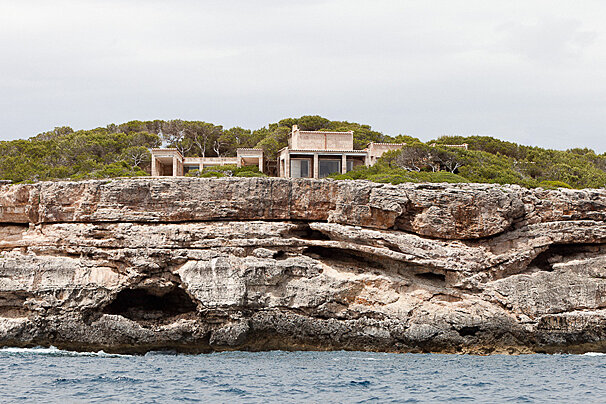
Jørn Utzon was a Danish architect who designed the iconic Sydney Opera House. He retired to Mallorca in the 1970's and built his house, Can Lis on the cliffs by Portopetro in the south east of Mallorca.

Can Lis was planned an organic, unified whole, its layout framing the day-to-day events that marked Utzon family life. Jørn Utzon's ideology centred on this very phenomenon - that architecture is not an external form: it is primarily the frame that encloses a collection of ritualized events. Precise studies in 1:1 of the site potential resulted in a set of interim drawings. Based on these drawings and with the help of the local building contractor Jaime Vidal, the house's final design emerged during the course of the building process.

Can Lis has been singled out by several leading architecture critics as one of the most important houses of the 20th century.

photo of a manor house at night

7. La Granja

This country house, just west of Esporles, is on a site known since Roman times for its natural spring. Since 1447 it has been a private house owned by various noble families; most of what you see today dates from the 17th century.

When Jaume conquered Mallorca he divided the island into four feudal estates, giving one to Count Nuno Sanc, who settled at La Granja. In 1239 the Count handed the estate to Cistercian monks to found Mallorca's first monastery.

Highlights of the tour include an aristocratic drawingroom with its own theatre, the family Chapel and a dungeon with a torture chamber, but the real reason for visiting La Granja is to learn about rural Mallorcan traditions. Workshops, cellars and kitchens contain displays of everyday objects. On Wednesday and Friday afternoons, women in traditional costume give demonstrations of lacemaking, embroidery and spinning, donkeys turn threshing wheels and there are tastings of cheese, wine, sausages, doughnuts and fig cake. Look carefully and you just might see a tray of coca (Mallorcan pizza) being removed from the restaurant oven and carried to the medieval kitchens to be served beside a log fire. There are also displays of bagpipe music and folk dancing, which are entertaining although perhaps not terribly authentic.

Escape from the tour groups by walking in the grounds, which contain botanical gardens, waterfalls and a thousand-year-old yew - there is a 1.2 km signed walk. Look out for the exhibit listed in the guide as 'dog' - it is just that, a ca de bestair, or black-coated Mallorcan guard dog on a chain.

If you have not gorged yourself on free samples, the restaurant serves good Mallorcan staples like pa amb oli, arros brut and sopas mallorquinas.

a photo of jardines alfabia mallorca majorca

8. Jardines Alfabia, Bunyola

These classical gardens by the entrance to the Soller tunnel are a legacy of the Arab talent for landscaping and irrigation. Their name derives from al fabi, 'jar of olives' in Arabic. They were probably designed by Benihabet, the Muslim governor of Inca who converted to Christianity following the Spanish invasion.

A flight of steps lined with tall palms leads to a covered walkway - from here you can strike off to see lily ponds, bamboo groves or citrus trees growing in the shadow of the mountains. If you have just driven over the Coll de Soller and are in need of a rest, this would make a lovely spot for a siesta.

Take a book or some postcards, find a seat in the shade, then drift off to sleep to the sound of gently flowing water. You may want to try their orange juice - apparently it is some of the best to be found on the island!

a photo of soller botanical gardens mallorca majorca

9. Soller Botanical Garden

Location
Soller

Sóller is a botanist’s and enthusiast’s paradise. The Botanical garden is found in a country estate known as “Camp d’En Prohom”, on the outskirts of Sóller. Its primary purpose is to preserve rare or endangered species of the Balearics, and is the result of many years of study and hard work, and now hosts one of Spain’s most extensive wild flora seed banks.

The Botanical Garden of Sóller combines traditional and popular architecture with botany, as it is structured on terraces that group the plants in the garden according to their ecological needs or use.

There are different kinds of plants found in the Botanical Garden of Sóller such as flora of the Balearic Islands; flora of other Mediterranean Isles, specially from Corsica, Sardinia, Sicily, Malta and Crete. There are also species from the Canary Islands, an ecological farm / orchard (with the aim of studying and preserving all horticultural varieties of traditional vegetables and fruit trees), plants for medicinal and aromatic purposes - with plants that have been used traditionally to heal and/or season, and ornamental plants.

They also preserve frozen seeds of those species under greater threat. In 1997 the foundation “Fundació Jardí Botànic de Sóller” was formed. Its headquarters are in an old building built in 1906 located within the same country estate. Used as a Botanical Institute, it is a centre of study and research, where the laboratories, library, seed bank and herbarium are kept.

The Museum of Natural Sciences is located in the gardens.

Botanicactus Botanical Gardens, Ses Salines

10. Botanicactus Botanical Gardens, Ses Salines

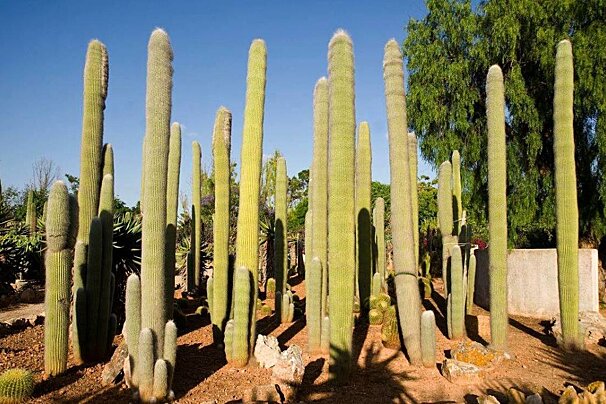
Botanicactus is one of Europe's largest botanical gardens, with bamboo and palm trees and dozens of varieties of cactus.

These gardens were opened in 1989 in Ses Salines because of the scarcity of rains in the area. The centre of the garden is full of cacti, surrounded by Mediterranean species. There is also a selection of tropical plants with a lake.

The cacti flourish in the dry and sunny climate and the landscape has been specifically designed to protect the plants, with the creation of the artificial lake and raised terraces protecting the plants from the wind.

Son Marroig, Deia

11. Son Marroig

Location
Deia

Of all the famous foreigners attracted to Mallorca's northwest coast, none is so admired locally as 'S'Arxiduc', Archduke Ludwig Salvador. Born in 1847 in the Pitti Palace, Florence, the son of Leopold III of Tuscany and Marie Antoinette de Bourbon, he came to Mallorca 20 years later to escape from Viennese court life and immediately fell in love with the island.

An ecologist before it was fashionable, and an early hippy who wore Mallorcan peasant clothes, he bought estates along the coast in an effort to save them from development, and devoted himself to studying and recording Mallorcan wildlife and traditions. His seven volume Las Baleares took 20 years to produce and is still an authority on its subject. He died in 1915 in a Bohemian castle.

The Archduke's home at Son Marroig, outside Deia, has been turned into a shrine to his memory, with his photographs, paintings and books and a museum devoted to his life. In the gardens is a white marble rotunda, made from Carrara marble and imported from Italy, where you can sit and gaze at the Na Foradada ('pierced rock') peninsula, jutting out to sea with a gaping 18m hole at its centre. Ask at the house for permission to walk onto the peninsula.

Thanks to the stunning marble temple on the cliff edge with panoramic views of the sea, Son Marroig has become one of the most iconic wedding venues in Mallorca. The venue is used for small, intimate ceremonies as well as large-scale events for up to 150 people. This is the perfect spot for a VIP wedding. The house also plays host to concerts throughout the year.

Raixa Estate, Bunyola

12. Raixa Estate, Bunyola

Raixa is a marvellous country mansion with gardens, parts of which date back to the 13th century. The house has passed through several noble families through the centuries, and was transformed to its present Italian style villa in the 18th century.

The origins of Raixa date back to an Islamic farmstead of which only the place-name remains. After the conquest of Mallorca by King James I of Aragón in 1229, these lands were granted to the count of Ampurias. During the Middle Ages, the property was owned by the Sureda de Sant Martí and Safortesa-Tagamanent families. The latter carried out a reconstruction at the beginning of the 16th century. The vault of the chapel and the porch of the courtyard are from that period.

In 1522 the house was burnt down by the followers of “las Germanías”, who supported the social struggles, because the owner at the time, Pere-Joan Safortesa i Descatlar supported the royal cause. During the last refurbishment of the house, traces from the fire have been discovered in a Gothic window inside the main room.

The first count of Montenegro, Ramon Despuig i Rocaberti, purchased Raixa in 1660, and from that time onwards, Raixa became the emblematic family estate. In the 18th century the houses were renovated and extended by the successive counts, as it was customary during the Baroque period. Dating from that time are the leisure gardens “les Llimoneres”, “La Gruta” and “Hort Nou”, already documented in 1740.

The estate consists of several homes arranged around a central courtyard, with several farm buildings. It is worth mentioning the south gallery, which was built around 1808, as well as the courtyard, around which the characteristic estate dependencies, such as the oil mill, the stables, the sharecroppers dwellings, etc., are distributed. An special mention must be made of the room where, according to tradition, Santa Catalina Tomàs stayed in the 16th century, when as a young girl she was part of the Safortesa-Tagamanent domestic service.

The present gardens date to the 19th century, and feature a large pond, the gardens of Apollo and the southern gardens. To the east lie faux 'ruins' (common for this period) such as a manmade grotto, a neo-Arabic view point and a neoclassical temple.