Castle / Ruins Sights in Mallorca — 12 of Our Favourites

Discover and book the top Mallorca sights

Capdepera Castle, Capdepera

1. Capdepera Castle, Capdepera

Location
Capdepera

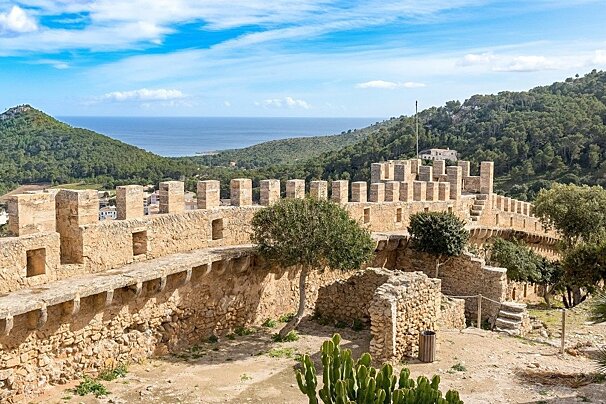
Capdepera was founded in 1300 and it was by royal decree that a fortress was built in which to house the residents, to protect them from pirates. This walled town became known as Capdepera Castle.

This fortified enclosure has roughly 82.5 m2 with a wall and a ditch standing on the top of a hill. In the 16th century, there were 125 houses inside its walls, but 200 years later it became a military outpost and most of the population lived outside. It was abandoned in 1856 and in 1983 it became municipal property.

Legend has it that the citizens of Capdepera hid in the castle when under siege, placing an image of Our Lady of Hope on the battlements, and the invaders were driven away by fog. The miracle is recorded inside the castle on the Capel de Nostra Senyora de la Esperança and is remembered each year at the town's annual fiesta.

Palace de l'Almudaina, Palma de Mallorca

2. Palace de l'Almudaina

Location
Palma de Mallorca

A royal palace has stood on this site next to Palma's cathedral since the Muslim walis (governors) built their alcazar soon after the Arab conquest.

It was converted into Gothic style under Jaume II, but elements of Islamic architecture remain - like the Moorish arches seen from the seafront, lit up at night like a row of lanterns. Inside you'll find tapestries, paintings and furniture from different time periods throughout its history.

The courtyard, laid out in 1309 and flanked by palm trees, is at its best in late afternoon when the sun falls on the cathedral towers overhead. Just off the courtyard is the royal chapel, Capella de Santa Ana.

The S'Hort del Rei gardens beneath the palace make a pleasant place to sit beneath the fountains watching the world go by. Look out for the Arc de la Drassana, once the gateway to the royal docks; near here is a statue of a hondero or Balearic slinger. The gardens were rebuilt in the 1960s, forcing the demolition of several houses; their best known landmark is Joan Miro's Egg sculpture, which few people can resist sticking their heads through.

Santuari de Sant Salvador, Arta

3. Santuari de Sant Salvador, Arta

Location
Arta

Much of this 4000 square metres complex has been restored so that you can now see the remnants of the medieval fortress that it once was.

The stone turrets line the top of the metre-thick walls. The views from here sweep over the rooftops of the medina-like old town and beyond to the bald, bumpy peaks of the Serra de Llevant.

The walls were built in the 14th century to protect the town from pirates or invaders. There are walkways and a simple cafeteria along the walls, and a neoclassical church, which was built in 1832.

a photo of an old castle in majorca

4. Santueri Castle, Felanitx

Santueri Castle sits on top of a rocky outcrop some 475 metres above sea level. It is a stunning, well preserved castle with remarkable views of the south east of Mallorca and the Cabrera Islands on a clear day. The present walls date from the 14th century but a fortification has existed here since Roman times.

The Moors certainly had a hand in re-building the castle during their occupation of Majorca between the 8th and 13th century. When King Jaume I invaded Mallorca for a second time in 1231, the castle was used as a refuge for the Moors and was beseiged by the Christians.

Legend has it that the Moors were tricked by the Christians after they found the castle to be impregnable. The locals held a party one evening with music and dancing, which distracted the Moors allowing them to be attacked from the other side of the castle. Not to be out-smarted, several of the Moors escaped to a defensible cave where they were surrounded again. The Christians thought they would be able to leave them to starve to death but the Moors taunted them by holding up fresh fish every day - what the Christians didn't know was that there was a tunnel at the back of the cave leading to the sea.

In 1811, the castle passed into private hands. After 13 years closed, you can now enter its interior where you will find a splendid central tower, ruins of ancient defensive structures, the old keeper's room, a cistern and many other constructions that tell the story of the life inside the castle.

Additionally, you can enjoy the walls and towers and of course the views. There are plenty of hiking and cycling trails in the area, or you can drive right up to the castle by taking the road from Felanitx to Santanyi.

a photo of a stone ancient settlement

5. Capocorb Vell, nr Cap Blanc

These are the most significant remains of the Talaiotic culture, which flourished in Mallorca between around 1300 and 800 BC.

It was dominated by talaiots (circular or rectangular structures) two to three storeys high, which were used as both burial chambers and defensive forts. Each settlement was surrounded by Cyclopean walls, built from massive, unhewn stones without mortar to hold them together. There is no evidence of a written language, so the stones are all that archaeologists have to go by in understanding prehistoric Mallorcan culture.

At Capocorb Vell, about 10km south of Llucmajor, you can see five talaiots and wander around the ancient village, 100m above sea level just inland from the coast. The Talaiotic people kept sheep and the sound of sheep bells in the nearby fields is a touching reminder of continuity.

a photo of alaro castle in majorca

6. Castell d' Alaro, Alaro

Castell d'Alaro is perched on top a rocky mountain above the town of Alaro in the west of Mallorca. A popular walk from the town (or further up the hill if you prefer to drive) takes you to a ruined castle and hilltop chapel offering spectacular views of the Tramuntana mountains and over towards Palma and all the way to the sea.

A castle has stood on this site since Moorish times; it was so impregnable that the Arab commander was able to hold out for two years after the Christian conquest. Later, in 1285, two heroes of Mallorcan independence, Cabrit and Brassa, defended the castle against Alfonso III of Aragon and were burned alive on a spit when he finally took it by storm. Their punishment was a consequence of their impudent defiance of the king. They pretended to confuse Alfonso's name with that of a local fish - anfos, shouting: "We like our anfos grilled." The present ruins date from the 15th century and seem almost to grow out of the rock, dominating the landscape for miles around.

The climb up here is one of Mallorca's most popular walks; do not go on a Sunday if you want to be alone. From the town of Alaro it takes about two hours, following the signs from the PM210 to Orient. You can also leave from Orient, following a small path opposite L'Hermitage hotel, again taking around two hours in total. The paths converge at Es Verger restaurant (you can even bring a car this far if you don't mind the potholes and the hairpin bends), where you can fill up with roast lamb to fortify you for the final steep climb.

At last you reach the castle, 800m above sea level. Look back at the view, stretching across the entire plain to Palma and out to sea. A few minutes further brings you to the summit, with a small chapel and sanctuary, and (bliss!) a restaurant and bar. If you are inspired by the views, you can stay the night here in one of the simple rooms.

Castell de Bellver Castle, Palma de Mallorca

7. Castell de Bellver Castle

Location
Palma de Mallorca

A well-preserved 14th-century royal fortress with fragrant pine woods, an interesting museum and superb views over Palma Bay.

Looking up at this castle, so perfectly maintained, it is hard to believe that it has been standing for almost 700 years. Begun by Jaume II in 1300 and built by Pere Salva, the architect of the Almudaina Palace, it is unique among Spanish castles in being entirely round.

Three large towers surround a central courtyard, connected by an arch to a free standing keep. The courtyard itself is on two levels, the ground floor with semicircular arches and a flat roof, the upper level with Gothic arches and rib-vaulting. For the full effect, walk around the moat then climb onto the roof and look down into the courtyard to compare the contrasting styles. While you are there, look out over the city and the bay for one of the best views in Palma. Bellver means 'lovely view' in Catalan.

For many centuries the castle was used as a prison; Jaume III's widow and sons were imprisoned here for most of their lives. These days it contains Palma's museum of municipal history, which traces the development of the city through its artefacts, with pottery from Talaiotic, Roman, Arab and Spanish periods.

a photo of the entrance to a taliot settlement on majorca

8. Ses Paisses, Arta

Location
Arta

This Bronze-Age talaiotic settlement near Arta is a significant site and a link with Mallorcans of 3,000 years ago.

Most impressive of all is the massive entrance portal, formed from three stone slabs weighing up to eight tonnes each. Inside there are several rooms and an atalaia (watchtower); the entire settlement is surrounded by a Cyclopean drystone wall.

The first excavations were carried out by Italian archaeologist Giovanne Lilliu, who focused on the village central area, the Talaiot and all the attached structures. Highlights in this area are the hypostile and the horseshoe-shaped room, among others. Excavation works were resumed 30 years later. The foundation of the settlement is dated circa 850 BC. It is believed that the village was built around the central Talaiot.

Son Real Archaeological Site, Santa Margalida

9. Son Real Archaeological Site, Santa Margalida

Situated within the Son Real public estate, the necropolis is still an active archaeological site. Acquired by the Balearic Islands Government in 2002 with the aim of preserving its natural and ethnological wealth and, in particular, the archaeological sites.

Within the complex of ruins you will find some round tombs (around 3 metres in diameter), whilst others are in the shape of a small square or rectangular "talaiots" (prehistoric towers), with many others being boat-shaped.  Rectangular holes in the wall can be seen in many of these tombs, but we still don't know what they were for.

There is still much to discover in this wonderful site that combines the history of the island alongside the wonderful marine and coastal environment. You can even learn about local customs and the ancient Balearic way of life.

There is also an archaeological museum set inside two renovated traditional Mallorcan houses. At this centre you can also rent bikes to visit the site.

Castell del Rei, Pollenca

10. Castell del Rei

The hike to this remote mountain castle, 7 km north of Pollenca, is one of the loveliest in Mallorca.

Founded by the Moors and strengthened by Jaume I, this was the last fortress to surrender to Pedro of Aragon when the brief-lived kingdom of Mallorca came to an end. It has been abandoned since 1715 and is rather romantic if you manage to be there by yourselves!

The castle is on a large private estate and you have to apply for permission at the Town Hall in Pollenca to get access. Please note that this permission can take up to four days to be granted.

Walk from Pollenca to avoid parking problems and allow at least five hours for the round trip. Take a look at the walking route described here for instructions on how to apply for permission (the castle is also known as Ternelles).

Coastal Watchtowers, Mallorca

11. Coastal Watchtowers

If you drive around the coast of Mallorca, you will find ancient towers or 'torres' that were used to guard the island against invasions by unwelcome visitors.

They date back to the 1500's when the Muslim pirates were sailing the seas of the Mediterranean. These defence towers were built by the Spanish to act as lookouts for boats of these pirates. Once pirates were spotted, a fire would be lit and the message transmitted down the coast all the way to Palma if necessary.

Read more on our report on The Ancient Coastal Towers of Mallorca

photo of an ancient village ruins

12. Roman Remains of Pollentia

Location
Alcudia

Pollentia was founded by the consul Qintus Caecilius Metellus in 123 BC in the strategic location between the bays of Pollenca and Alcudia. It was the most important city in the Balearics duing the Roman period and covered an area of 15-20 hectares.

Artefacts of the site were first discovered in the 17th century but excavations were not started until 1923. The work still continues today and is funded by the Consorci de la Ciutat Romana de Pol-lentia.

There are three areas open to the public – the theatre, the forum and the residential area of La Portella. There is also a museum, the Museu Monografic de Pol-lentia in the centre of Alcudia (by the church) which displays many of the objects found on the site.