Museum / Gallery Sights in Palma de Mallorca — 13 of Our Favourites

Discover and book the top Palma de Mallorca sights

A painting of a cactus is on display in a museum

1. Rialto Living Art Gallery

Location
Palma de Mallorca

Rialto Living is Palma's most famous interior design and concept store. Located right in the heart of the city, it has a small art gallery inside with temporary art exhibitions.

Rialto Living used to be an old cinema which has been renovated and turned into a stunning home interiors shop. Owners Klas Kall and Barbara Bergman decided to use one of the spaces for an art gallery, where to showcase the best local artists as well as contemporary international names.

Their temporary exhibitions change regularly. After checking out the artworks, you can relax with a coffee and a snack at Rialto Cafe.

Open Monday to Saturday from 11:00 to 19:00.

a photo of  the foundation la caixa building

2. Fundacio La Caixa

Location
Palma de Mallorca

The Gran Hotel was Palma's first luxury hotel when it opened in 1903. Designed by the Catalan architect Lluis Domenech I Montaner, it was the building that began the craze for modernists (art nouveau) architecture in the city.

Restored by the Fundacio la Caixa and reopened in 1993, it is now an art gallery featuring changing exhibitions and a permanent display of paintings by Hermen Anglada-Camarasa, the founder of the 'Pollenca School'.

The building is wonderfully intricate, with detailed tiling, a vast array of stone carvings, balconies and ornate iron railings. On the ground floor there is a bookshop specialising in design and a trendy cafe-bar.

a photo of museo de mallorca palma majorca

3. Museu de Mallorca

Location
Palma de Mallorca

Billed as Mallorca's most important museum, this undoubtedly contains some fascinating exhibitsbut beware that it is difficult to get excited about bits of stone in glass cases if you do not understand the captions. The museum has recently been refurbished, so we are hoping it is now more tourist-friendly.

Talaiotic and Roman remains are followed by Moorish ceramics and Christian art, providing a quick overview of Mallorcan history. It's worth going just to see the building, a 17th-century palace built on the foundations of one of Mallorca's earliest Arab houses.

Monday to Friday: 11:00 to 18:00 h. Saturdays: 11:00 to 14:00 pm. Closed on Sundays and public holidays. Entrance is free.

Museu de Sa Jugueta (Toy Museum), Palma Centre & Marina

4. Museu de Sa Jugueta

Location
Palma de Mallorca

Based on the collection of Antoni Roig Clar, this museum showcases over 3,000 toys from all around the world and from different eraas.

There are pieces from Spain, Germany, Japan, America... ranging from dolls to small theatres, mechanical toys, toy horses, bicycles and much more. These toys are authentic survivors, since around 80% of new toys break on the first days after being bought.

The museum also organises temporary exhibitions and weekly activities for children such as concerts, workshops, games, film screenings, theatre performances, etc.

There is also a great restaurant serving lunch and snacks, from traditional Mallorcan llonguets to a Mediterranean-inspired daily lunch menu with vegetarian options. The bar is open until late at night serving small bites and snacks.

a photo of museo diocesa palma mallorca majorca

5. Museu Diocesa

Location
Palma de Mallorca

This small museum of religious and historical antefacts is based in a wing of the former episcopal palace tucked behind the cathedral.

The bishop's palace, located right behind the cathedral, was originally built in the 13th century. Although its main style is Gothic, it has undergone various renovations throughout the centuries that have changed its initial image.

Among the paintings, pulpits and prayer books are splendid Arab tapestries, a collection of ceramics spanning five centuries and a 17th-century painting of baby Jesus carrying a cross. Look out for the portrait of St George (Sant Jordi) with medieval Palma in the background.

a photo of la llotja palma mallorca majorca

6. Sa Llotja, Palma de Mallorca

Location
Palma de Mallorca

With twin turrets and an angel over the door, this 15th-century seafront building looks half-castle, half-church. In fact it is neither.

It was designed by Guillem Sagrera (the architect of the cathedral's Portal del Mirador) as the city's exchange when Mallorca was a major maritime trading centre in the 15th century.

As trade declined through the centuries, Palma ceased to have so much commercial importance and the building changed its use according to need. It was used as a store for goods and guns during the War of Independence and became a gallery for fine art at the end of the 19th century.

The rectangular hall has an octagonal tower at each corner, with ten smaller towers to act as buttresses. Stand among the spiralling pillars, gaze up at the rib vaulting, and try to imagine the Mallorcan merchants of 500 years ago haggling over silk, spices and silver.

Nowadays La Llotja is a cultural centre, hosting temporary exhibitions.

The inside of a building with arches and columns

7. Casal Solleric

Location
Palma de Mallorca

A wonderful 18th-century Baroque building with feature courtyard and decorative touches, Casal Solleric is now home to temporary exhibitions specialising in contemporary art and photography.

The building was constructed by the Morell family in the mid-eighteenth century and it is one of the last manor houses built in Palma. The layout is attributed to the Mallorcan architect Gaspar Palmer, while the wrought iron and sculptural decoration are the work of Italian artist Antonio Soldati.

In 1985 it was inaugurated as Exhibition and Documentation Centre of Contemporary Art, run by the City Council of Palma through the Fundació Palma Espai d’Art. It Programmes temporary art exhibitions throughout the year in its various exhibition spaces: main floor, mezzanine, ground floor and Espai Quatre. In accordance with its interdisciplinary character, Casal Solleric has also housed collective exhibitions of design and comics as well as exhibiting the works selected for the annual photography and painting prize “Ciudad de Palma".

Fundacio Pilar i Joan Miro, Cala Major

8. Fundacio Pilar i Joan Miro

The painter and sculptor Joan Miro spent most of his life in Barcelona, but both his wife and mother were Mallorcan and he always longed to return to the scene of his childhood holidays to draw inspiraton from what he called "the light of Mallorca".

 In 1956, aged 63, he bought a house and studio in Cala Major. He lived here until he died in 1983 after which the house was enlarged to hold a permanent exhibition of his works.

The collection includes more than 100 paintings, 25 sculptures and 3,000 studio pieces, but only a small amount is displayed at any time. The paintings are almost childish, all vivid splashes of bright primary colours, influenced by his love of peasant traditions and his fascination with siurells (clay whistles).

Anyone tempted to remark that their child could do better should take a look at the heavily realistic work that Miro was producing aged eight - the fantasy came later. Works on display include the draft for UNESCO's Mural del Sol in Paris. Glance into Miro's studio, left untouched since his death, with work in progress, open tins of paint and black stains all over the floor.

a photo of sculptures in palma

9. Es Baluard Museu

Location
Palma de Mallorca

Es Baluard Museum of Modern & Contemporary Art  was opened in 2004 as a cultural institution for research and dissemination of Balearic & Mediterranean art from the 20th and 21st centuries.

The museum is housed in a former military fortress - the Baluard de Sant Pere - which dates back to the 16th century, and was part of the Renaissance wall that surrounded the city of Palma.

The collection of the Foundation Es Baluard consists of paintings, sculptures, ceramics and drawings by artists emerging from the late 19th century: Cézanne, Gauguin, Picasso, Miro, Picabia, Magritte, Giacometti , Motherwell, Tàpies, to more recent artists such as Horn, Plessi, Polke, Kiefer, Schnabel, Barceló, and Scully. There are also outstanding examples of Catalan and Mediterranean landscapes, and artists who directly or indirectly have been associated with the Balearics: S. Rusiñol, J. Mir, A. Gelabert, H. Anglada-Camarasa, J. Or MH Mompó Ramis, among others. 

Es Baluard was developed by the government and has an annual budget provided in equal shares by the Mallorcan counsel (Consell), the Balearic government (Govern) and Palma´s town hall (Cort). The public museum is however managed by a private foundation, chaired by Pedro Serra, who has also personally donated many of the gallery's art pieces. 

The museum covers a total surface of 5,027 square metres, with 2,500 sq.m of exhibition space. The museum features one of the largest cisterns from the 17th century, known as 'The Aljub'.  This fresh water reservoir was used to supply the Sant Pere quarter,as well as ships that used to dock in the harbour. It is now used as a setting for installations of contemporary artists, and for shows and concerts.

The exhibition space extends on to large terraces and external spaces, from where you can enjoy wonderful views of the Bay of Palma. There is a  book and gift shop, and a highly regarded restaurant on one of the terraces. There are no foreign language texts in the museum (only Spanish & Catalan) or audio guides, as the collections are refreshed every 3 months or so, and it is not practical to provide them.

a photo of three paintings by miro

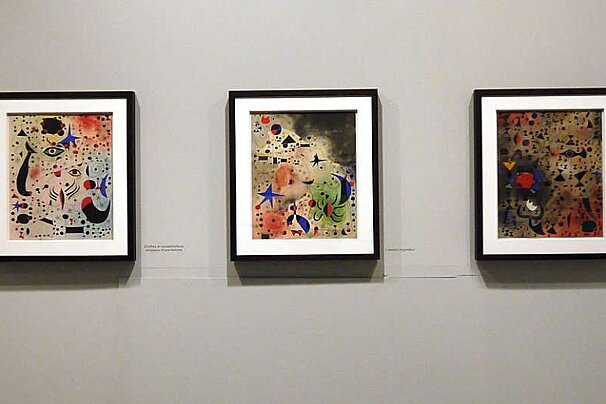
10. Joan Miro: Graphic Works

Location
Palma de Mallorca

Curated by his grandson, Joan Miro Punyet, this exhibition will show case up to thirty of Miro's graphic works, many of which were inspired by, or created on, the Balearic Islands.

Hosted in the unusual venue of Palma Station on the Ferrocarril de Soller, the exhibition will give visitors the chance to see many works previously not on display.

Poble Espanyol - Spanish Village, Palma de Mallorca

11. Pueblo Español - Spanish Village

Location
Palma de Mallorca

Spain gets the theme-park treatment at this 'village' in the outskirts of Palma, where reproductions of famous buildings from Cordoba, Toledo and Madrid are gathered together with typical houses from the Spanish regions.

A visit here gives you a whistle-stop tour of Spanish architecture, showing its development through Muslim and then Christian influences. It's actually very nicely done. If you have never been to Granada, it's worth coming just for the reproduction of the salon, baths and patio from the Alhambra Palace.

You can eat Spanish food in the Plaza Mayor (Spanish spellings here) or sit outside a cafe watching the tourists buy pearls and souvenirs at the village shops. Various artists give displays of handicrafts in workshops scattered throughout the 'village'.

a photo of spanish contemporary art collection palma mallorca majorca

12. Museum of Spanish Contemporary Art (Colleccio March)

Location
Palma de Mallorca

The Museu Fundación Juan March houses a small collection of 20th century Spanish art shich belonged to the Mallorcan banker Joan March, once one of the world's richest men.

It is housed in a 17th-century mansion that was originally built as a residence, but was redesigned in the early 20th century and turned in to a museum in 1990.

There are just 70 pieces, each by a different artist, including Picasso, Dali and Miró. Thus, the collection displays examples of contemporary mid-twentieth century art with works by some of Spain's most recent emerging artists. A total of fifty-two artists are represented. 

In 2009, the collection was joined by a permanent new gallery devoted to the graphic work of Pablo Picasso. The museum also has special exhibition galleries that feature the work of artists represented in the collection as well as exhibitions dedicated to contemporary artists and major modernist trends.

Palau March Sculpture Gallery, Palma de Mallorca

13. Palau March Sculpture Gallery

Location
Palma de Mallorca

Just next to the cathedral is the impressive Palau March (Bartolome March Foundation) with a great collection of 20th century sculpture.

The gallery features famous artists such as Henry Moore, Barbara Hepworth, Max Bill, Pietro Consagra and Agustin Cardenas. Famous Spanish artists on display include Miguel Ortiz Berrocal, Francisco Otero Besteiro, Xavier Corberó and Eduardo Chillida. A variety of materials, textures, colours and shapes transform the space into a powerful and evocative garden art gallery. A highlight is a bronze sculpture by Auguste Rodin, 'Torse d'Homme qui tombe' (1882).

The building itself was built in 1939 by Madrid architect Luis Gutierrez Soto, with no expense spared. The historical discourse dominates in the building, heavily influenced by the Mallorcan and Italian Baroque Palaces. Hidden from view is the inner courtyard, a wonderfully Mediterranean affair, highly decorated and elegant.