
Rialto Living Art Gallery
Rialto Living is Palma's most famous interior design and concept store. Located right in the heart of the city, it has a small art gallery inside with temporary art exhibitions.
Discover and book the top Palma de Mallorca sights
Rialto Living is Palma's most famous interior design and concept store. Located right in the heart of the city, it has a small art gallery inside with temporary art exhibitions.

This small museum of religious and historical antefacts is based in a wing of the former episcopal palace tucked behind the cathedral.

Es Baluard Museum of Modern & Contemporary Art was opened in 2004 as a cultural institution for research and dissemination of Balearic & Mediterranean art from the 20th and 21st centuries.

A royal palace has stood on this site next to Palma's cathedral since the Muslim walis (governors) built their alcazar soon after the Arab conquest.

Based on the collection of Antoni Roig Clar, this museum showcases over 3,000 toys from all around the world and from different eraas.

Billed as Mallorca's most important museum, this undoubtedly contains some fascinating exhibitsbut beware that it is difficult to get excited about bits of stone in glass cases if you do not understand the captions. The museum has recently been refurbished, so we are hoping it is now more tourist-friendly.

With twin turrets and an angel over the door, this 15th-century seafront building looks half-castle, half-church. In fact it is neither.

The Gran Hotel was Palma's first luxury hotel when it opened in 1903. Designed by the Catalan architect Lluis Domenech I Montaner, it was the building that began the craze for modernists (art nouveau) architecture in the city.

A wonderful 18th-century Baroque building with feature courtyard and decorative touches, Casal Solleric is now home to temporary exhibitions specialising in contemporary art and photography.

Just next to the cathedral is the impressive Palau March (Bartolome March Foundation) with a great collection of 20th century sculpture.

Spain gets the theme-park treatment at this 'village' in the outskirts of Palma, where reproductions of famous buildings from Cordoba, Toledo and Madrid are gathered together with typical houses from the Spanish regions.

The painter and sculptor Joan Miro spent most of his life in Barcelona, but both his wife and mother were Mallorcan and he always longed to return to the scene of his childhood holidays to draw inspiraton from what he called "the light of Mallorca".

The Museu Fundación Juan March houses a small collection of 20th century Spanish art shich belonged to the Mallorcan banker Joan March, once one of the world's richest men.

The facade of this 13th-century church in Palma (remodelled after it was struck by lightning in the 17th century) is typically Mallorcan - a massive, forbidding sandstone wall with a delicately carved postal and a rose window at the centre.

The glory of Palma - a magnificent Gothic cathedral whose sandstone walls and flying buttresses seem to rise out of the sea.

The small and charming square of Plaça Cort, located in the heart of the city, is famous for the ancient olive tree ('Olivera de Cort') that stands in the centre. The square is named 'Cort' because it was here where the feudal court gathered. The town hall dominates the plaça, built between 1649 and 1680 by local architects Pere Bauçá, Miquel Oliver and Bartomeu Calafat, its façade has been decorated with Mannerist and Baroque style features.

The Plaça Major is Palma's main square and one of the busiest in Palma being also a city landmark. Rectangular in shape and surrounded by historic arcaded buildings, it was once the headquarters of the Inquisition. This rectangular space surrounded by traditional yellow buildings with green shutters has been the centre of the city life throughout the centuries.
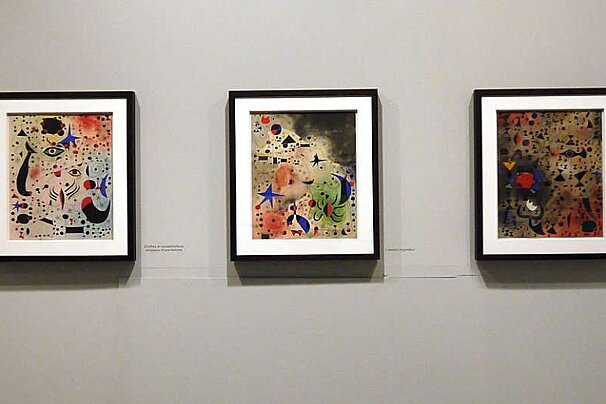
Curated by his grandson, Joan Miro Punyet, this exhibition will show case up to thirty of Miro's graphic works, many of which were inspired by, or created on, the Balearic Islands.